
Foggy, Cracked, or Broken Glass? The Window Itself Might Be Fine.
We replace just the glass — on windows and doors — without touching the frame. Fast, clean, and backed by a 5-year warranty on the new glass unit.
Book a Free Glass AssessmentRequest an estimate
Sound Like Any of These?
| Common Signs Your Glass Has Failed | What’s Actually Happening |
| 🌫️ Fog or haze between the panes that won’t wipe away 💧 Moisture or water droplets visible inside the double/triple pane glass units 🪟 White or chalky residue between the panes ❄️ Noticeably cold glass even when the heater is running 🔨 A crack, chip, or broken pane from impact 🌬️ Drafts you can feel at the glass edge 📈 Rising heating bills you can’t explain If any of these match what you’re seeing — your frame may still be in perfect condition, and only the glass unit needs replacing. | Most of these symptoms are caused by seal failure — the hermetic seal around your insulated glass unit (IGU / double or triple pane unit) has broken down, allowing moisture to enter the cavity between the panes. This is a very common problem, especially in Alberta where freeze-thaw cycles put repeated stress on window seals year after year. IGU (double/triple pane) seals typically last 15–25 years, and when they fail, the glass unit can be replaced independently without disturbing your frame, sill, or trim. The result: a clear, properly insulating window at a fraction of the cost of a full window replacement. |
Not All Condensation Means Your Window Is Broken
Where the condensation appears tells you everything you need to know. There are three locations — and only one of them means something is wrong with your window.
On the outside of the glass — This is actually a good sign. It means your windows are insulating so well that the outer pane stays cold even as warm air hits it from outside. Like dew forming on grass in the morning, this evaporates as the sun warms up the glass. No action needed.
On the inside surface of the glass (room side) — This is a humidity issue, not a window failure. Warm, moist indoor air is hitting the cool glass and condensing on the surface — the same way a cold glass of water sweats on a hot day. It’s more common in bathrooms, kitchens, and bedrooms. You can usually reduce it by improving ventilation: run exhaust fans longer, keep interior doors open, and avoid covering windows with heavy drapes that trap cold air against the glass. In Edmonton winters, a healthy indoor humidity level is typically between 30–40% relative humidity. If condensation is heavy and persistent indoors, a hygrometer (inexpensive at any hardware store) can confirm whether your home’s humidity is elevated.
Between the panes — This is the one that requires attention. Condensation trapped between the panes of a double or triple pane window means the hermetic seal has failed. The insulating gas has escaped, moisture has entered, and the window is no longer performing the way it should. This will not clear on its own. The IGU needs to be replaced.
If you can wipe the moisture off with your finger, it’s on the surface — a ventilation issue. If it’s trapped and won’t wipe away, it’s between the panes — call us for an assessment.
What Is Glass Replacement?
The insulated glass unit — or IGU — is the sealed assembly that sits inside your window frame. It consists of two (or three) panes of glass separated by a spacer, filled with argon gas, and hermetically sealed at the edges.
When the seal fails, the gas escapes and moisture enters — causing the fogging and condensation you can see. But the frame, the sash, and the hardware are often completely unaffected.
Glass replacement means we remove only the failed IGU from your existing frame and install a new one. We measure the exact dimensions, manufacture or source the new unit to spec, and fit it into your existing frame — sealed, insulated, and ready to perform.
There is no damage to your interior trim, exterior siding, or surrounding walls. No mess, no disruption, and no need for a full window replacement.
We replace glass in windows of all types — casement, slider, double-hung, fixed, bay, bow — and in all door styles including patio doors, French doors, and entry door glass inserts.
Can I Upgrade from Single to Double Pane, or Double to Triple, Without a New Frame?
The Short Answer: No — and Here’s the Honest Reason Why
This is one of the most common questions we hear: ‘Can you just add another pane to my existing window?’ It’s a completely reasonable thing to ask — and the answer is no, but not for the reason most people assume.
The reason isn’t cost or convenience. It’s physics.
Every window frame is built with a glazing channel — the slot or rebate that holds the glass unit in place. That channel has a fixed depth, designed to accept an IGU of a specific total thickness. A single pane unit might be 6mm thick. A standard double pane IGU is typically 20–28mm total — glass, spacer, gas, and sealant combined. A triple pane unit is thicker still.
If your window frame was built for a single pane, the glazing channel is too shallow to physically accept a double pane unit. If your frame was built for a double pane unit, the channel won’t accommodate a triple pane. You cannot compress the unit to make it fit, and forcing an oversized unit into an undersized channel damages both the frame and the seal — leading to faster failure, not better performance.
The only correct way to increase the number of panes in your window is to replace the entire frame with one built to the right depth for the thicker unit.
What we can do when replacing your IGU: While you can’t add panes, you can meaningfully upgrade performance within the same pane count by switching to Low-E coated glass, adding argon gas fill (available with Low-E glass), upgrading to a thicker glass lite, or choosing laminated or acoustic glass. These upgrades fit within your existing frame depth and deliver real thermal, noise, and safety improvements.
If you’re looking for maximum energy performance and your frames are older, the honest recommendation is a full frame replacement — which gives you the right glazing channel for a triple pane unit and addresses any frame degradation at the same time. We’ll always tell you which option makes more sense for your specific situation.
What Kind of Glass Can I Upgrade To?
When we replace your glass unit, you can keep the same specification as your original — or upgrade the glass performance within the same unit thickness. Here are the upgrades that are physically possible within your existing frame:
| Glass Upgrade | What It Does | Worth It? |
| Low-E (Low-Emissivity) Coating | Near-invisible metallic coating that reflects heat — keeping warmth inside in winter and solar heat out in summer. The single most impactful glass upgrade available. | ✅ Strongly recommended — minimal cost, significant performance gain for Edmonton’s climate |
| Argon Gas Fill | Improves the unit’s U-value (insulating performance) by up to 16% compared to an air-filled unit. Important: argon gas fill is only available in combination with Low-E coated glass — it cannot be added to a standard clear glass unit. | ✅ Yes — whenever choosing Low-E glass, add argon for the full performance benefit |
| Reflective / Solar Control Glass | Reflects sunlight away from the home to reduce heat gain and glare. Exterior may appear slightly mirrored or tinted. Useful for south and west-facing windows with heavy sun exposure. | ✅ Yes — for rooms that overheat in summer or have excessive glare |
| Noise Reduction / Acoustic Glass | Thicker or laminated panes that reduce sound transmission. Available in double and triple pane configurations. | ✅ Yes — for rooms near busy roads, schools, or multi-unit buildings |
| Laminated / Safety Glass | Holds together if broken instead of shattering. Improves security and reduces injury risk. | ✅ Yes — for ground-floor windows, patio doors, entry sidelites, and any high-risk area |
| Laminated Art Glass | A custom interlayer — such as a family photo, decorative pattern, or artistic design — permanently bonded between two panes of glass. Retains all safety glass properties while creating a one-of-a-kind panel unique to your home. | ✅ Yes — for feature windows, entryway sidelites, interior glass partitions, and custom projects. Always a custom order — contact us to discuss. |
| Privacy / Pattern Glass | Lets natural light in while limiting visibility. Multiple textures available — frosted, reeded, glue chip, pinhead, mirror. | ✅ Yes — for bathrooms, entryways, glass partitions, basement windows near grade |
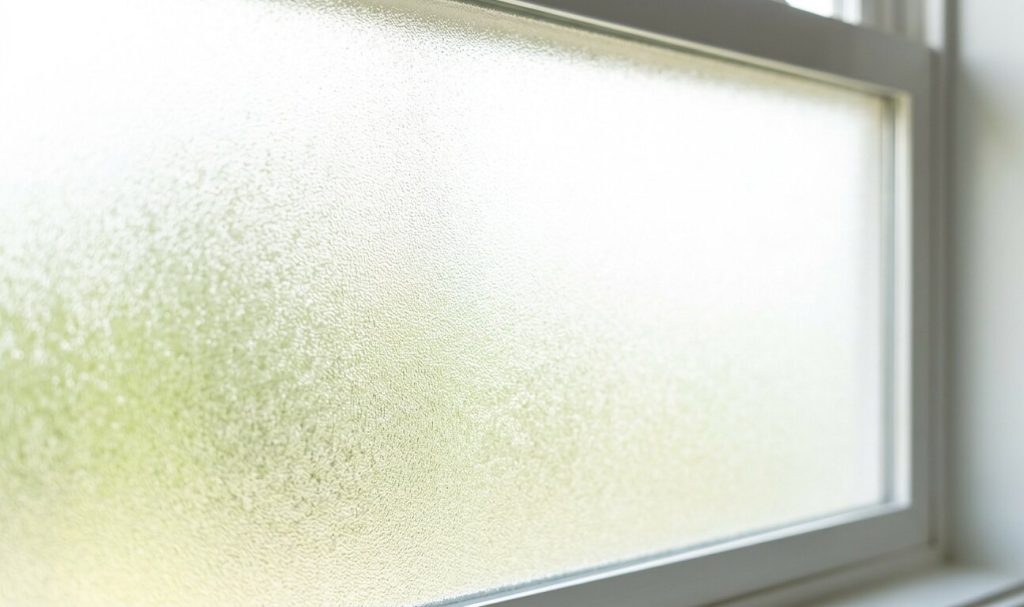
Frosted Pattern Glass
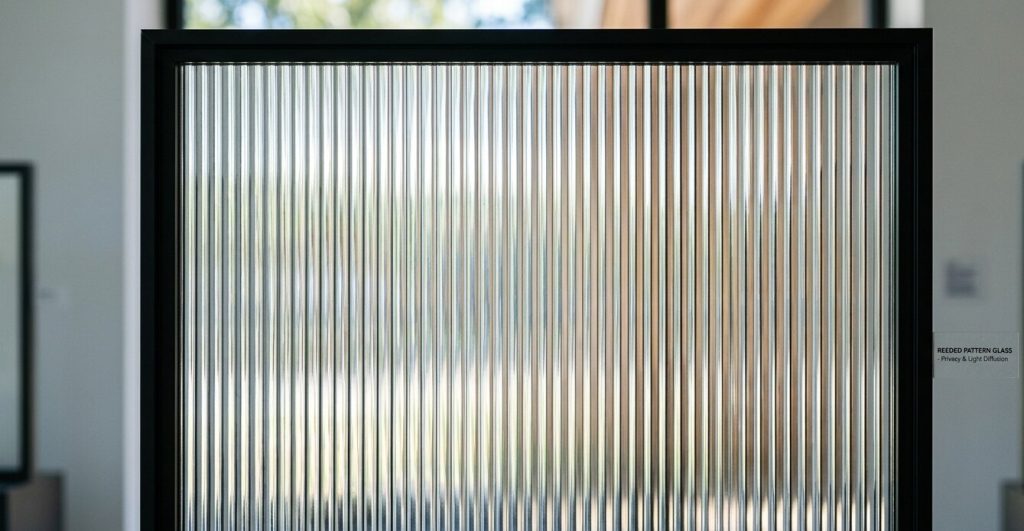
Reeded Pattern Glass
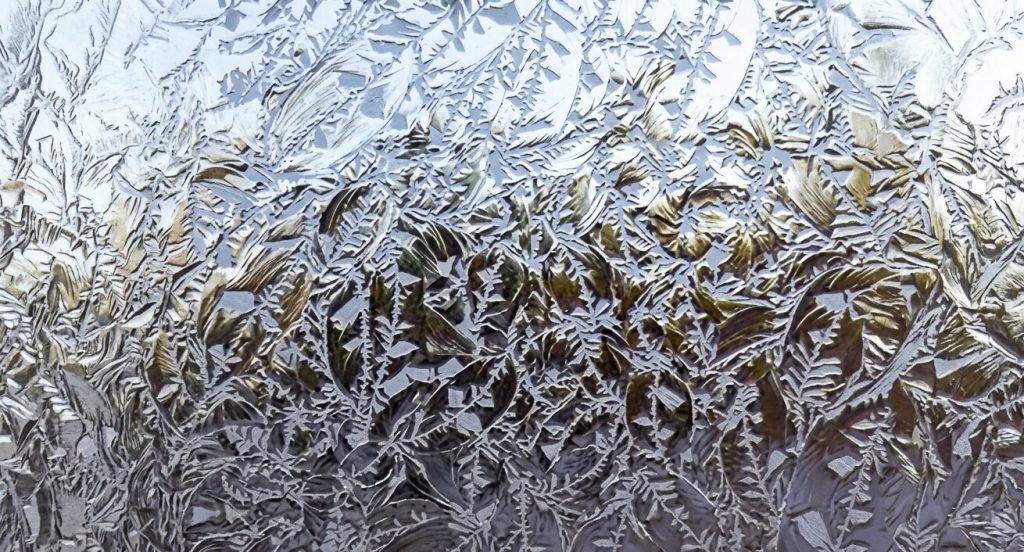
Glue Chip Pattern Glass
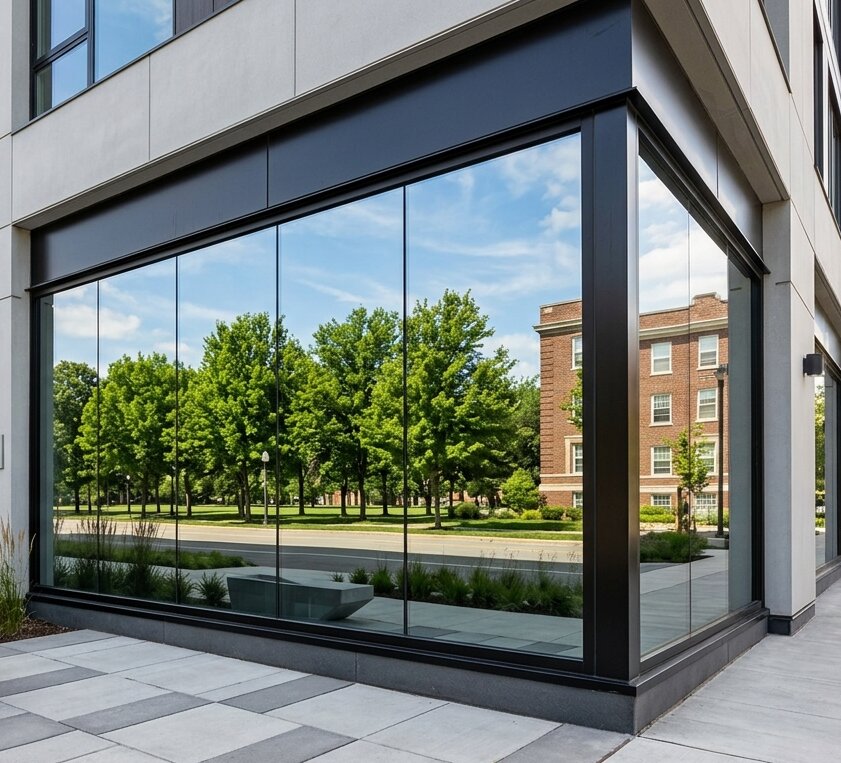
Mirror Glass
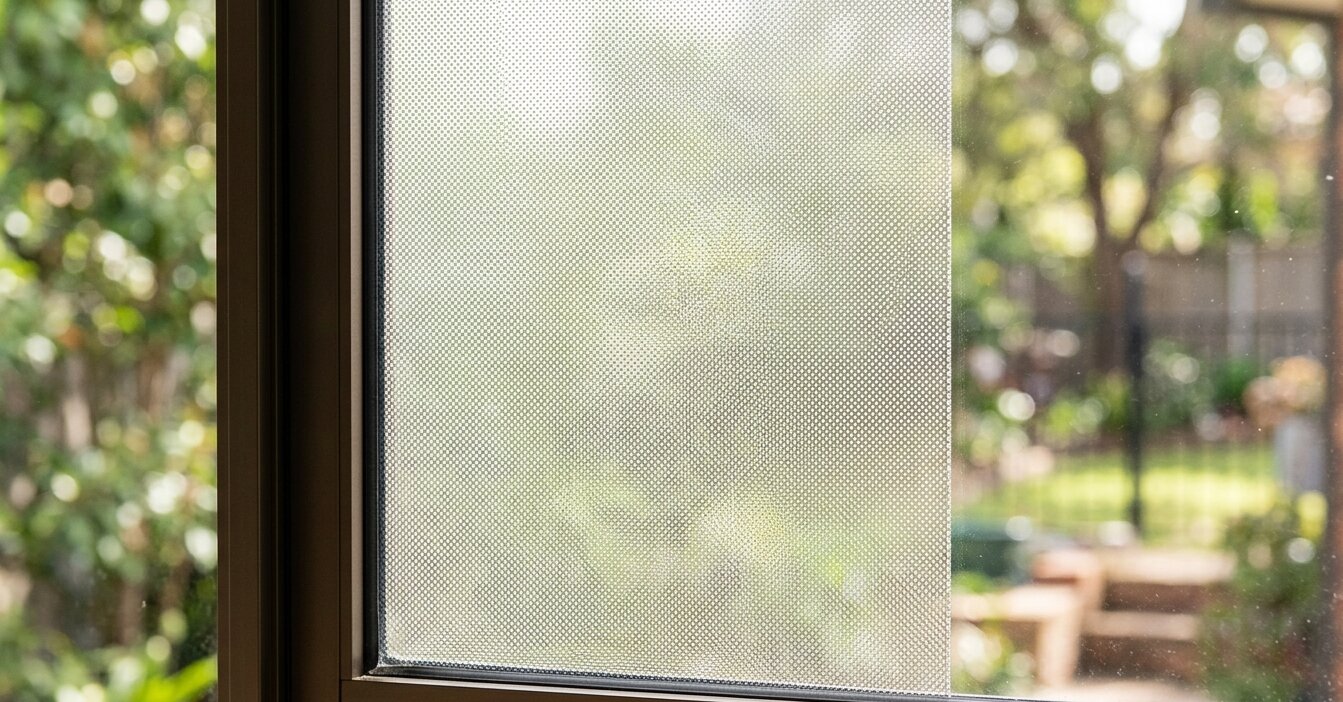
Pinhead Pattern Glass
How Different Glass Types Break
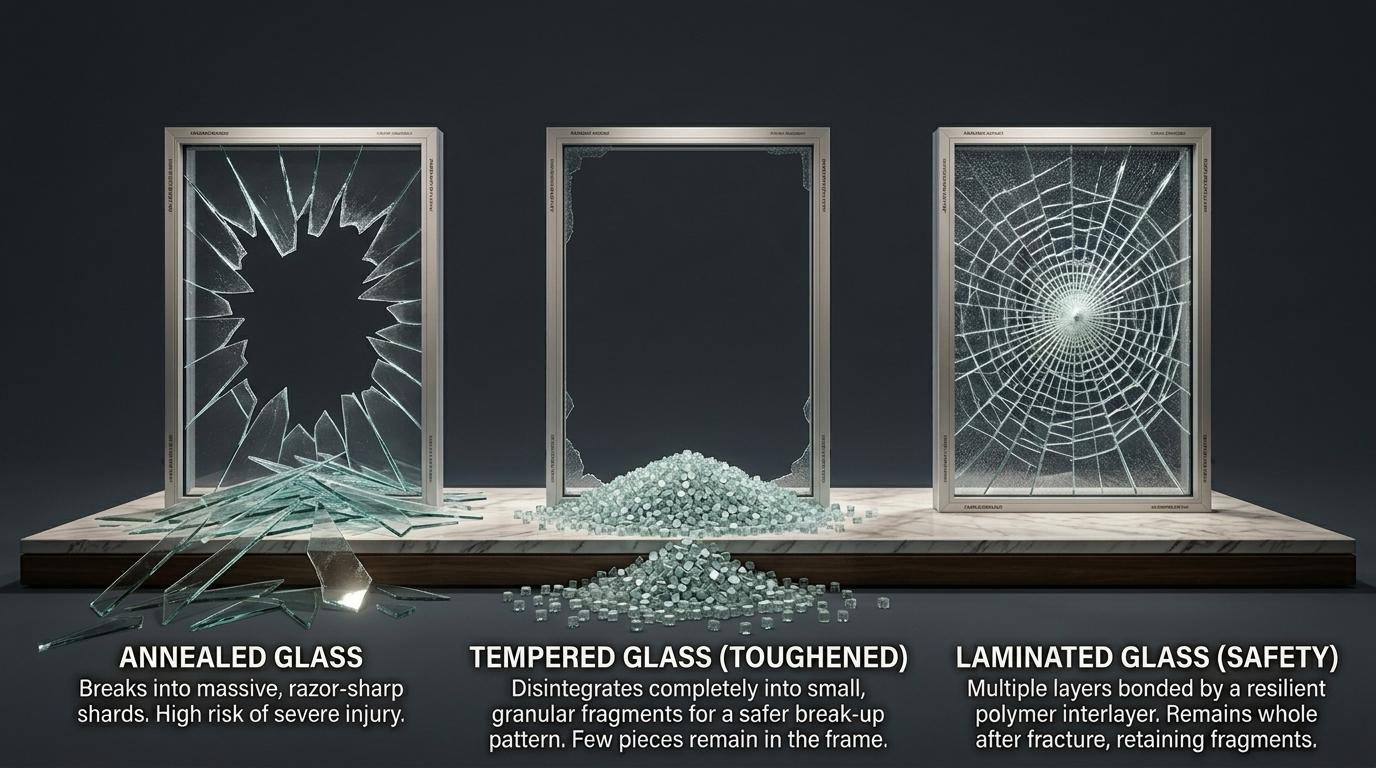
Not all glass breaks the same way — and the difference matters. If you’re choosing a glass type for a replacement, understanding break behaviour helps you make the right decision for safety, security, and your household.
| Glass Type | How It Breaks | What It Means for You |
| Annealed (Standard Float) | Breaks into large, sharp shards with jagged edges. The crack radiates outward from the point of impact, producing long splinters that stay near the frame. | Standard glass used in most IGUs. Higher laceration risk on breakage. The opening is immediately exposed and requires prompt boarding or replacement. |
| Tempered (Safety Glass) | Shatters completely into thousands of small, blunt-edged pieces (often called “dice”) rather than sharp shards. The entire pane disintegrates at once when the break threshold is reached. | Significantly safer than annealed on breakage. Required by code in doors, large openings, and areas near floor level. The opening is exposed immediately — but the risk of serious laceration is greatly reduced. |
| Laminated (Safety Glass) | May crack under pressure but stays intact. The PVB (polyvinyl butyral) interlayer holds the broken pieces bonded together — the pane cracks but does not fall out of the frame or scatter. | The safest break behaviour. The opening remains covered even after impact — reducing injury risk and maintaining a barrier against entry. Best choice where security or fall protection is a priority. |
Can the Glass in Any Window Be Replaced?
In most cases, yes — as long as your frame is structurally sound.
We can replace the glass unit in virtually all standard residential window types: casement, awning, double-hung, single-hung, slider, fixed picture windows, bay and bow windows, and most specialty shapes.
For doors, we replace glass in: patio sliding doors, French doors, garden doors, storm doors, and entry doors with decorative or standard glass inserts.
The rare cases where glass replacement is not the right solution are when the frame itself is damaged, rotted, or structurally compromised. In that situation, we will tell you honestly during the assessment — and we can then quote a full frame replacement instead.
We will never replace just the glass when we know the frame needs replacing too. That would be doing you a disservice.
How the Process Works
| Step | What Happens |
| 1. Free Assessment | We inspect your window or door, check the frame condition, confirm the glass unit has failed (and not something else), and measure the exact dimensions of your IGU. |
| 2. We Quote You Clearly | You receive a written quote covering the glass unit, labour, and any additional work required. No hidden charges. |
| 3. Unit Manufactured or Sourced | Because we manufacture IGU units in-house, we can often produce your replacement unit faster than competitors who rely entirely on external suppliers. |
| 4. Old Unit Removed | We carefully remove the glazing stops, extract the failed IGU, and clean the frame channel. |
| 5. New Unit Installed | The new glass unit is set into the frame with proper shimming, the stops are replaced, and the perimeter is sealed. |
| 6. Inspection & Cleanup | We verify the unit is level, properly sealed, and visually clean. All old materials are removed and the space is left tidy. |
What’s Covered by Our Warranty
Every glass unit we supply and install is backed by a written warranty. Here’s what it covers:
| Coverage Area | Period | Details |
| Seal Integrity (Fogging/Moisture) | 5 Years | If the new unit’s seal fails and causes fogging or moisture between panes, we replace it. |
| Insulating Performance | 5 Years | For argon-filled units, insulating performance is guaranteed not to degrade significantly. |
| Material Defects | Day of Installation | Cracks, chips, or distortion from manufacturing defects — covered if identified on the day of install. |
| Low-E Coating Integrity | 5 Years | If coatings degrade and affect visibility or performance — covered. |
| Workmanship | 1 Year | Installation issues such as misalignment or poor sealing — covered if affecting performance or safety. |
| 🚫 EXCLUSIONS — What Is Not Covered | |
| Accidental Breakage | Not covered. |
| Natural Disasters / Vandalism | Damage from storms, earthquakes, or intentional harm is not covered. |
| Improper Use or Modifications | Using thermal drapes, tinting, or film that cause glass stress will void the warranty. |
| Structural Movement | If building shift causes strain on the glass unit, this is not covered (may be covered by home warranty). |
| Supply Only | If windows were purchased as supply-only, installation labour for warranty replacement is not covered. |
⚠️ NOTE What the warranty does not cover: Accidental breakage · Storm or vandalism damage · Damage from tinting, film, or thermal coverings applied after installation · Structural movement of the building causing stress on the glass unit.
Not Sure If It’s the Glass or the Frame?
That’s exactly what our free assessment is for. We’ll tell you honestly what the problem is — and what it will take to fix it properly.
📍 Serving Edmonton and surrounding areas · 📞 780-717-6115 · We respond within 1 business day